
Jugaad at the Frontier
Anthropic has secured commitments of 1.7GW of heavy-duty Caterpillar gas-fired generators for $3.4bn through a deal with San Antonio, Texas-based equipment supplier OnePWR Solutions.
Compute, the processing power of specialized chips used to train and use AI models is by far the biggest cost. Most AI labs rent compute from hyperscalers, the big three being Amazon Web Services (AWS), Microsoft Azure, and Google Cloud. Labs want to vertically integrate into power, moving from renting compute to controlling energy supply.
As per JLL's 2026 Global Data Center Outlook report:
...the average wait time for a grid connection in primary data center markets exceeds four years.
For a new 50MW data center (see Table below) it ranges from about 2 years (Dallas, Phoenix, Mumbai) to about 7 years (Northern Virginia, Paris, Frankfurt, London) and about 10 years (Tokyo, Amsterdam). Dublin is paused until 2028 as capacity limits have been reached, creating a risk of rolling blackouts.
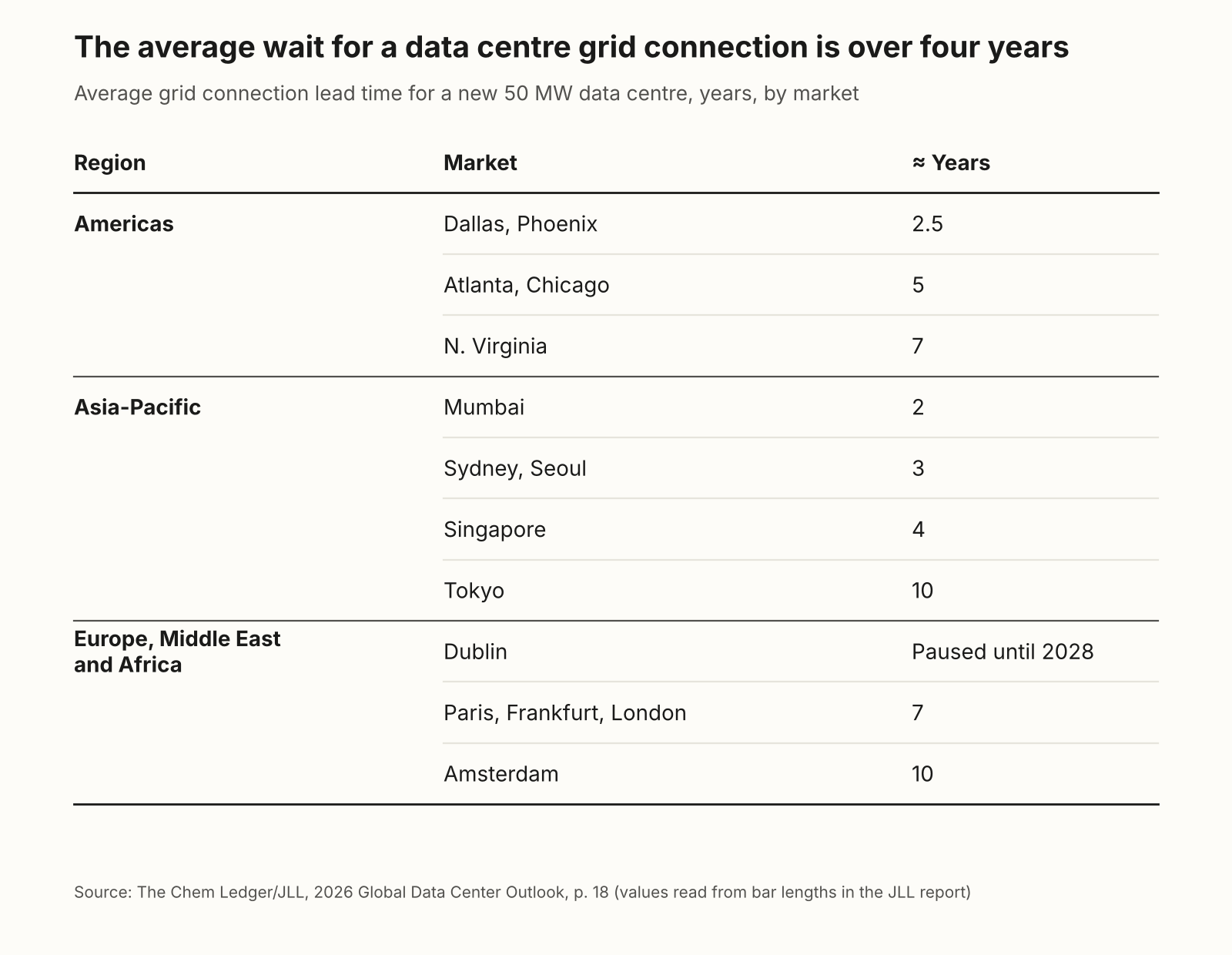
To whittle the wait time down to 12-24 months, hyperscalers and AI labs resort to on-site gas-powered generators. The scarce input has ceased to be intelligence and become things that arrive on trucks. Whoever holds the queue position may hold the future. This is jugaad at frontier scale.
Meanwhile, Elsewhere
Miscalculated Bet
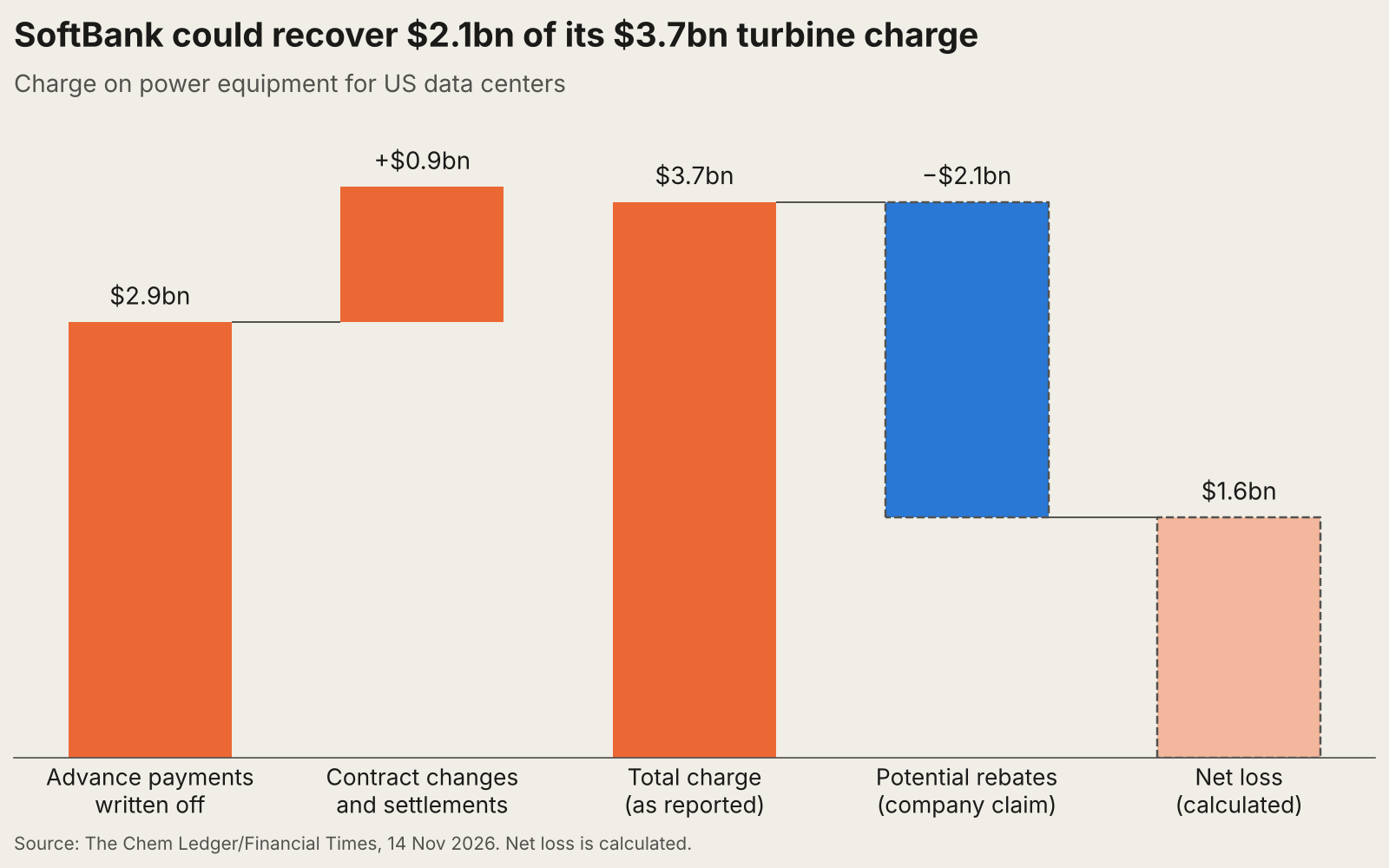
SoftBank took a $3.7bn charge on power equipment orders for data centers in the US. Most of it was small gas turbines. The $3.7bn loss comprised $2.9bn in written-off advance payments and around $900mn related to contract settlements, though the company may recoup $2.1bn through potential rebates (see chart below). Despite the write-down, SoftBank reported that its own data center business demand has exceeded expectations.
Offshore Data Centers
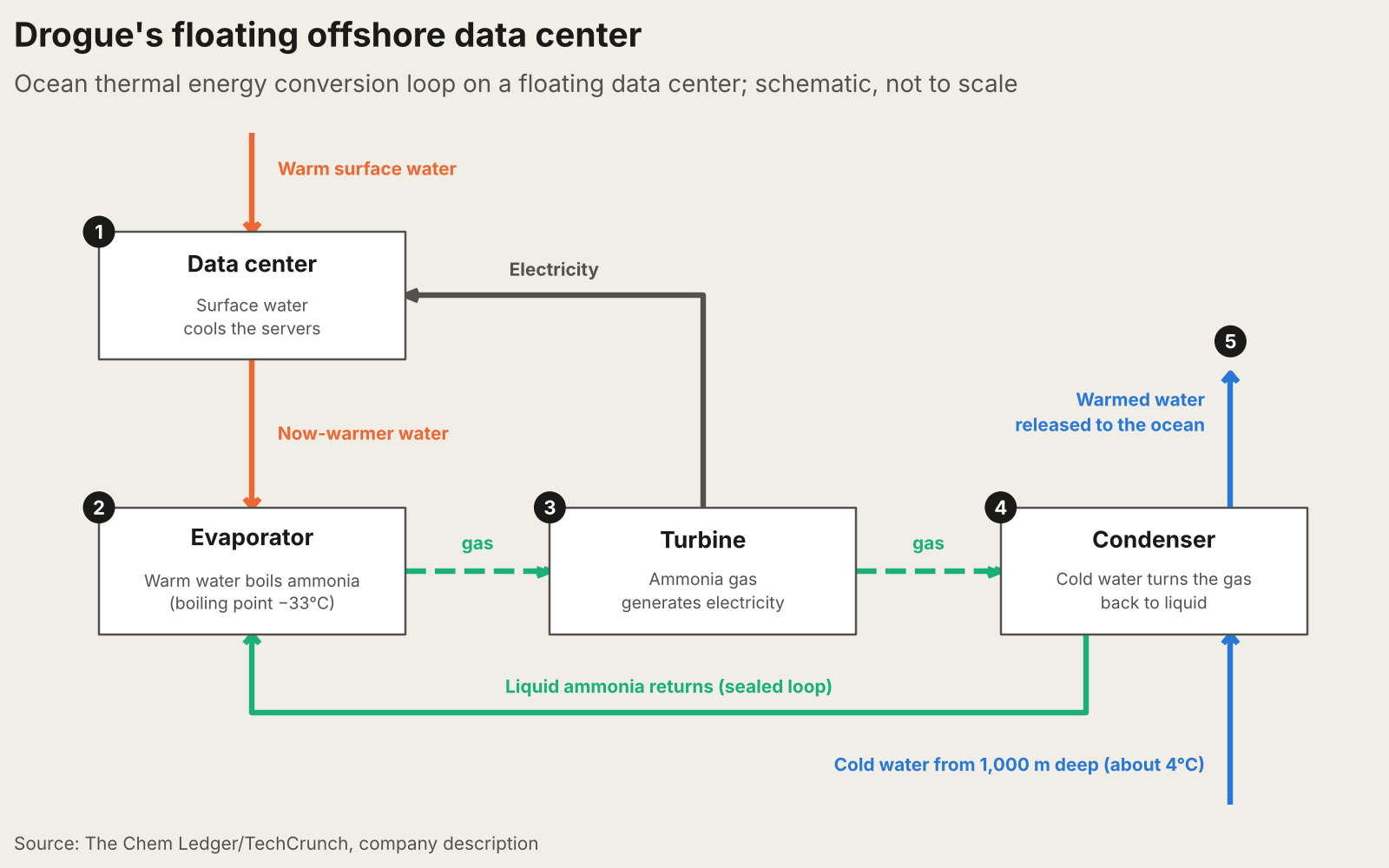
Drogue, a Washington, D.C. startup, raised $20mn to build floating offshore data centers powered by ocean thermal energy, using the temperature difference between deep and surface seawater to generate electricity in a closed ammonia loop and cool servers with seawater. The startup plans to launch a multi-megawatt (exact power not stated) prototype on an oceangoing ship by early 2028, with future versions modelled after offshore oil platforms.
The closed ammonia loop works in five steps:
- Warm surface water is drawn in to cool the data centers.
- The now-warmer water boils ammonia (b.p. = -33.34 oC).
- Ammonia gas runs a turbine to generate electricity.
- The gas goes to a condenser and turns back into a liquid. Cold water from 1000 meters deep passes over the condenser's fins and absorbs the heat.
- The warm water is released and dissipates into the ocean. Ammonia returns to the start of the loop.
Drogue has received a preliminary sign-off from the American Bureau of Shipping, which sets and checks ship safety standards, for its system.
Three Stories, One Constraint
Anthropic is spending $3.4bn to jump a queue. SoftBank took a $3.7bn charge to get out of one. Drogue secured $20mn on the idea that the way around the grid is to float past it.
Jugaad means making do with what's at hand. At the frontier, what's at hand is a gas generator, and the bill runs to billions. A place in the queue is only worth having if there is a data center waiting at the end of it.
Member discussion