Build or Buy
BASF, the world's largest chemicals company by sales, wants to grow by acquiring a smaller German rival, Evonik. A decision made nearly two decades ago could hold the key to the takeover.
In 2007, the German government, the states and the trade unions created RAG-Stiftung (foundation) to manage the end of hard-coal mining in the Ruhr, Saar, and Ibbenbüren regions. By the end of 2018, the last coal mines closed.
A body created to manage an ending now decides a beginning. Today, the foundation holds around 43% of Evonik.
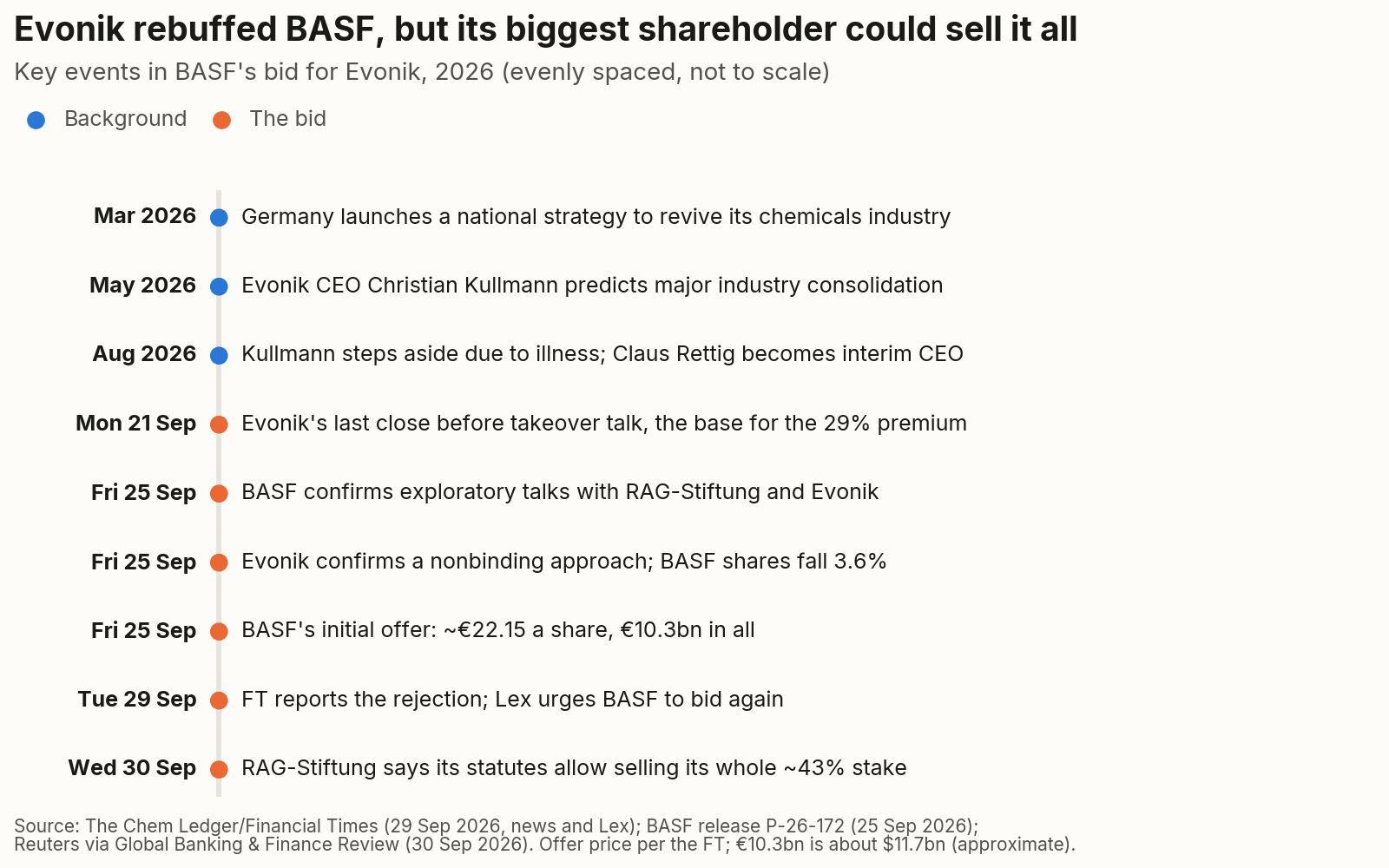
If the foundation decides to let go of its entire stake, which "under the foundation's statutes" is possible, it will clear the way for BASF to achieve what it set out to. That would create a combined entity with annual revenues exceeding $84bn.
According to C&EN's Global Top 50, an annual ranking of the 50 largest chemical companies in the world by chemical sales, the same four German companies, BASF, Evonik, Covestro and Bayer, made the list in 2024 and 2025. All four had lower sales, and their combined chemical sales fell from $113.5 bn to $108.8bn, a 4.1% drop in dollar terms but closer to 8% in euros. (see Table)
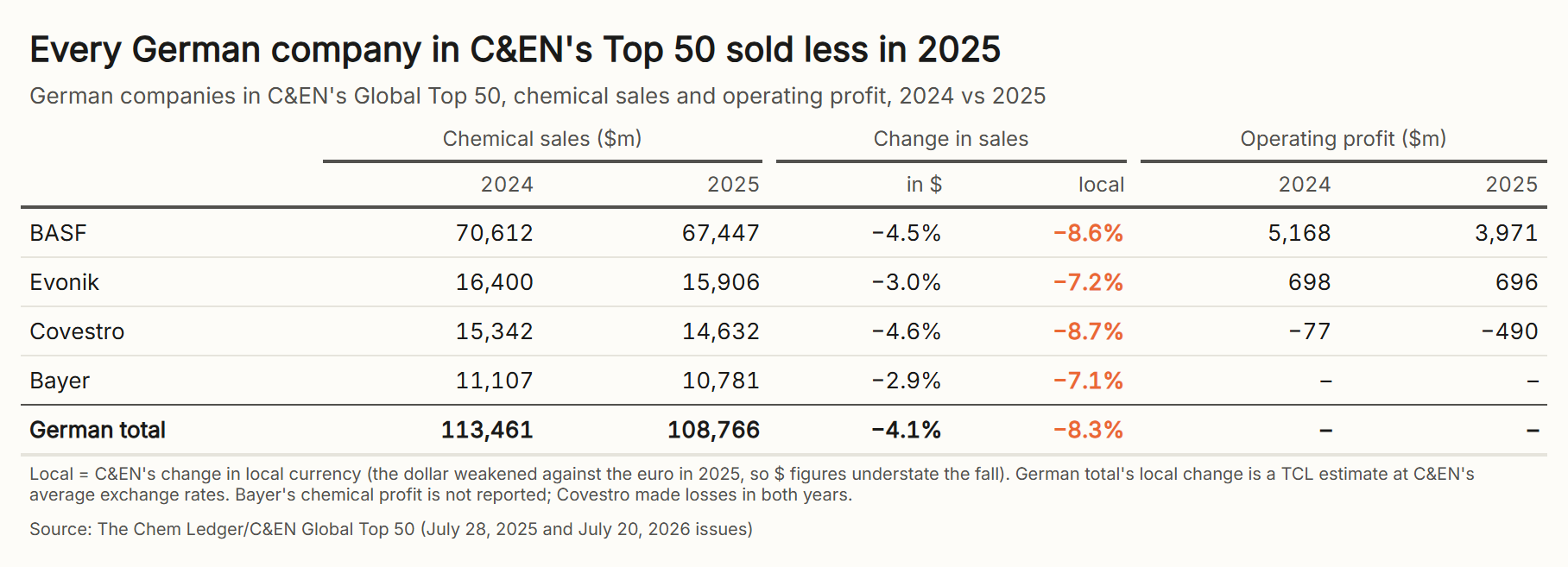
Profits were weak too. BASF's chemical operating profit fell by about a quarter in 2025 compared to 2024. In a shrinking market, the quickest way to grow is to buy a rival.
However, not everyone came to the same conclusion this week. A rare-earths startup and a fuels trader are building plants of their own. Following are other sector updates that caught my attention.
Rare Earths
Starting January 1, 2027, new US defense procurement rules will ban Chinese-origin rare earth magnets and minerals from American military weapons systems. However, major US suppliers aren't positioned to meet the volume demand. A startup is racing to fill that gap.
A new 500 tonnes per year (t/y) rare earth metal production plant is coming up in Nevada. Called Solcoa One, it will be operated by Solcoa Industries, which was founded in 2025. Last week, the startup received a total of $75m led by Bain Capital Ventures and J.P. Morgan in an equity and debt structure.
The Solcoa One site, scheduled to begin operations in July 2027, will focus on neodymium-praseodymium and samarium metal to support robotics, electrification, and defence sectors. Solcoa's current capacity is a 10 t/y pilot plant in Alameda, California, where they use a halide-free chemistry as opposed to molten-salt electrolysis (chloride/fluoride baths).
Aviation Fuel
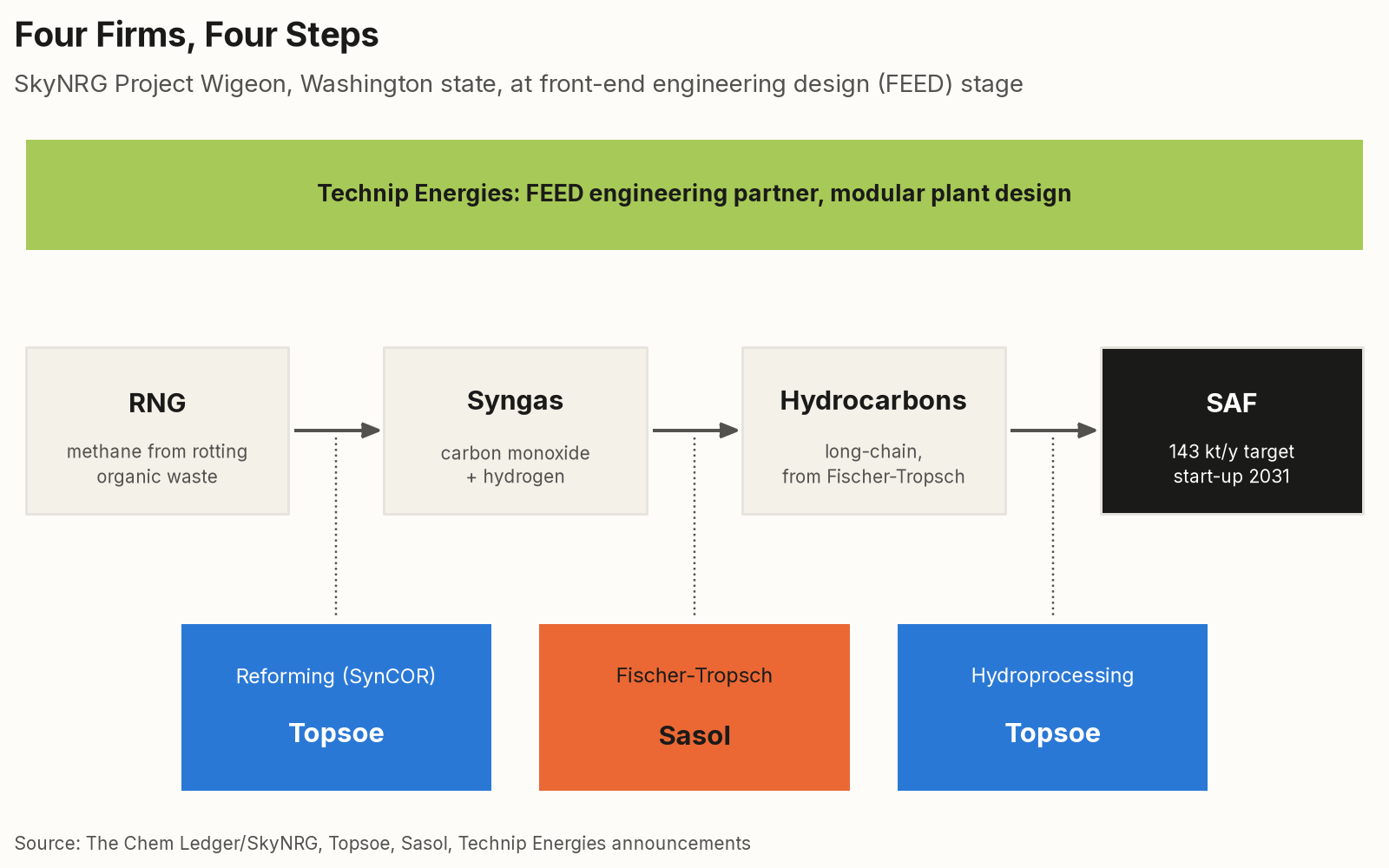
SkyNRG, a Dutch sustainable aviation fuel (SAF) company, is teaming up with Technip Energies, Sasol, and Topsoe for front-end engineering (FEED) on Project Wigeon in Washington. Wigeon is one of SkyNRG's three SAF projects as it transitions from trading and blending SAF to building its own plants.
The Wigeon site aims to produce 143 kt/y of SAF by converting renewable natural gas (RNG) (methane made from rotting organic waste) using the Fischer-Tropsch process, with a targeted start-up in 2031.
Topsoe's SynCOR reformer will turn RNG into syngas, a mixture of carbon monoxide and hydrogen. Sasol will employ the Fischer-Tropsch process to build syngas into long-chain hydrocarbons. Topsoe's hydroprocessing will upgrade those hydrocarbons into jet-compatible SAF. Technip Energies is the engineering partner and will be responsible for the plant's modular design.
Biotech
AstraZeneca will invest $2 billion in Summit Therapeutics, a Miami-based oncology company. The kernel of the equity deal is Ivonescimab, a PD-1/VEGF bispecific antibody.
The two companies will run trials pairing Ivonescimab with AstraZeneca's antibody-drug conjugate sonesitatug vedotin (licensed from KYM Biosciences in March 2023) across multiple gastrointestinal cancer indications.
Ivonescimab was engineered by Akeso, a Chinese biopharmaceutical company. Summit holds the rights in major territories outside China.
So, do we build or do we buy? Buy the growth if you can't find it at home. Build if there isn't enough supply to buy.
Member discussion