
TCL #61: The Cost of EV Reassessment
Plus: Sub-1nm node ambitions and Quantum Computing for Computational Chemistry.

Welcome back to The Chem Ledger. Today's newsletter delves into updates that caught my eye in the EV, Battery, Semiconductors, and Quantum Computing sectors. If someone forwarded this newsletter to you, you can have direct access here.
EV
China's largest automaker BYD, is exploring the possibility of building a manufacturing plant in Canada and is open to acquiring an established global automaker. The company plans to own and operate the factory independently, rather than through a joint venture. While BYD does not currently have a consumer presence in Canada, it does operate an electric bus manufacturing facility north of Toronto. BYD views the US market as complicated due to tariffs and bans on connected car technology, and is currently shelving ambitions for US market entry. Having established a significant presence in Brazil, the company is focusing on expanding in markets like Europe and Turkey.
On the other hand, Honda has halted development of three electric vehicle (EV) models previously intended for US production. Honda cited the rapid shift in the EV market, reduced subsidies in North America, and intense competition from Chinese manufacturers as reasons for scaling back EV ambitions. The company anticipates up to $15.7 billion in expenses and losses due to this reassessment of its EV strategy. This marks Honda's first net loss since decades, with charges expected to be split between the current and next fiscal years.
Battery
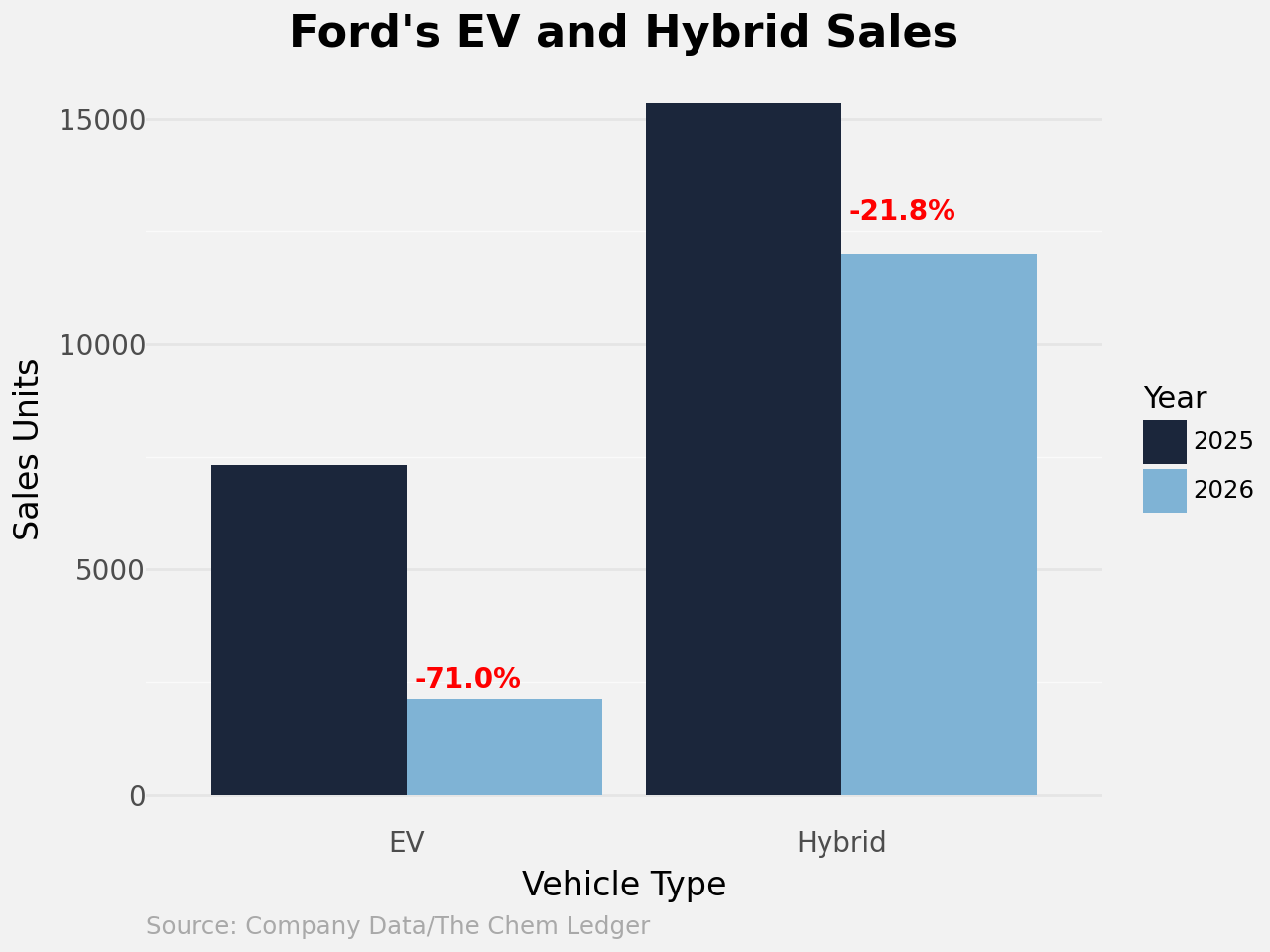
Rio Tinto is slowing the construction pace of its Nemaska lithium processing plant in Bécancour, Quebec, due to surging costs. In the coming weeks, minimal staff will remain on-site and full project restart is anticipated in 2027. Despite the slowdown, Rio Tinto will continue significant investment in Quebec lithium operations, allocating over $300 million in 2026, and expects no major changes to the project's overall timeline. The Bécancour facility is over 70% complete, with operations previously expected to commence in 2028. Nemaska has a long-term supply agreement since 2023 with Ford Motor Co., for lithium hydroxide, a crucial component for EV batteries. Ford's EV sales saw a significant drop of 71% in February 2026 compared to the same period last year. Hybrid sales were down 22% (see chart above).
Elsewhere, aptly named Group14 Technologies has launched the world's first EV-scale factory for silicon battery materials in Sangju, South Korea, producing 2,000 tons of SCC55 annually, enough for around 100,000 EVs. This expansion aims to meet the demand for silicon anode batteries, which offer higher energy density and faster charging times compared to traditional carbon anodes. Group14's technology addresses the durability issues of silicon anodes by using a hard carbon scaffold that prevents swelling and crumbling.
Semiconductors
IBM and Lam Research have announced a five-year collaboration to advance logic scaling to the sub-1nm node. The partnership will focus on developing novel materials, advanced fabrication processes, and high numerical aperture extreme ultraviolet (NA EUV) lithography techniques. The collaboration will leverage IBM's research capabilities at the Albany NanoTech Complex and Lam's process tools, including Aether dry resist and various etch and deposition systems.
Quantum Computing
Infleqtion, a Colorado based quantum tech company, has been awarded $3.9 million in federal funding from the US Department of Energy's ARPA-E to use quantum computing for innovations in chemistry and materials science. The funding is part of ARPA-E's Quantum Computing for Computational Chemistry (QC3) program, which aims to accelerate simulations for commercial energy applications like superconducting power lines and advanced batteries. Infleqtion will use its neutral atom quantum computer and a new algorithm to discover high-temperature superconductors and materials with zero electrical resistance.