
TCL# 60: BYD's New Battery, Aikido's Underwater Data Center, TerraPower's NRC Approval
Plus: Replacement of copper interconnects with fiber optics and scaling a new biomaterial

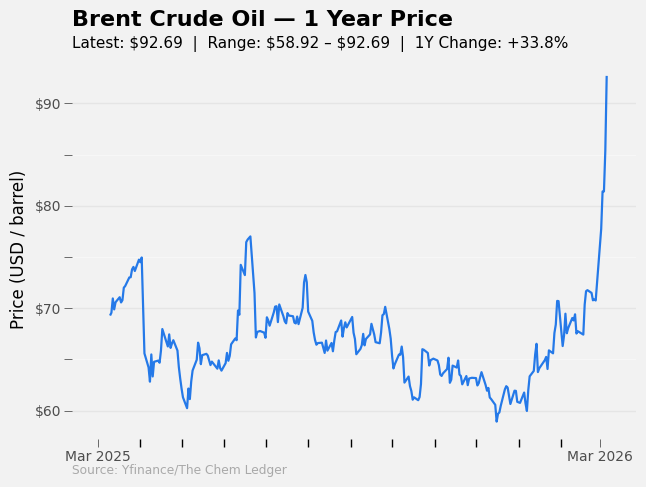
The war in Iran has sent the price of Brent Crude Oil Futures, the global benchmark price for oil, to around $92 per barrel as of March 7, 2026 (see Chart below) from ~$70 per barrel at the end of January. This has taken away the safety halo surrounding the energy security of many nations. This is a reminder to everyone to invest in and develop alternative, reliable, and scalable energy sources for such times.
This week's newsletter includes developments in alternative energy sectors as well as updates in biomaterials and semiconductor sectors.
Battery
BYD has introduced a new EV battery, the Blade Battery 2.0 system, capable of charging from 10% to 70% in five minutes. This speed is only achievable when coupled with BYD's new 1.5 megawatt FLASH Charging EV chargers. The new battery pack utilizes lithium iron phosphate (LFP) chemistry, which is cheaper than alternatives like cobalt or nickel. The Chinese EV giant plans to install 20,000 FLASH Charging stations in China by the end of 2026 and will roll them out internationally. The DENZA Z9GT, from BYD's premium brand, will be the first European vehicle to feature the new battery pack and ultra fast charging capability.
Zeno, a company focused on the production of battery-swap electric motorbikes, has raised $25 million in Series A funding. Zeno operates in Kenya, Uganda, and India. The funding includes $20.5 million in equity, led by Congruent Ventures with participation from Active Impact and Lowercarbon Capital, and a $4.5 million debt facility from Camber Road and Trifecta Capital. Previously, the company raised $9.5 million in a seed round led by Lowercarbon Ventures and Toyota Ventures. Zeno's Emara motorbike can travel about 60 miles on a single charge, carry up to 550 pounds, and costs approximately $1,300 without a battery or $2000 with. The company is also developing a battery dock for homes and businesses to provide power, aiming to integrate into the region's electrical infrastructure.
Offshore Wind
Offshore wind power harnesses the energy of winds at sea to generate electricity for the onshore grid. Aikido Technologies, a company operating in this sector, is developing a concept that integrates offshore wind turbines with underwater data centers. The first prototype, a 100 kW unit, is slated for launch in the North Sea off Norway by the end of the year, with a potential 15 to 18 MW project planned for the coast of the United Kingdom in 2028. Aikido's design features a semisubmersible platform with three outward protruding legs, each ending in a ballast tank containing fresh water for buoyancy. These tanks will house the data centers, with the water used for liquid cooling of the servers.
Nuclear Tech
The US Nuclear Regulatory Commission (NRC) has approved TerraPower to build a new nuclear reactor in Wyoming. This is the first permit issued by NRC in nearly a decade. TerraPower's Natrium reactor, designed with GE Vernova Hitachi, will generate 345 MW and use molten sodium for cooling. The reactor design includes storing excess energy as heat in insulated tanks, allowing it to supplement intermittent renewable energy sources like wind and solar.
Semiconductors
Ayar Labs, a San Jose-based chip startup, has secured $500 million in Series E funding, valuing the company at $3.8 billion. Investors include Nvidia, Advanced Micro Devices, Neuberger Berman, MediaTek, and Qatar Investment Authority. Ayar is developing advanced applications of co-packaged optics to modify semiconductor connections within server racks, aiming to replace slower, energy- consuming copper interconnections with faster fiber-optic ones. The startup is focused on improving AI chips, addressing bottlenecks in AI processing by using silicon photonics to transmit data via photons instead of electrons.
Qnity Electronics, Inc. announced a $61.5 million investment in a new advanced semiconductor research and manufacturing facility in Taiwan, slated to begin operations in early 2027. The new facility, located in the Hsinchu Science Park, will expand Qnity's capacity to meet growing demand for advanced-node chips and advanced packaging. The facility will support high-performance manufacturing at scale, featuring production areas, clean rooms, warehousing, research labs, and office space. Qnity was separated from Dupont's Electronics business into a new entity on November 1, 2025, and has 39 manufacturing sites and 17 research labs globally.
Biomaterials
Shellworks, a London-based biomaterials company, has secured $15 million in a Series A funding round led by Alter Equity, to scale its sustainable plastic alternative called Vivomer. Vivomer is made from fermentation of waste biomass and is designed to biodegrade within 52 weeks in home compost conditions. Shellworks has developed 3 manufacturing methods, kept 3 tonnes of plastic out of marine environments, and prevented 150 tonnes of plastic waste.